NC Injury Law, PLLC Helps You Understand Your Crash Report
Following a car accident, one of the first official documents you’ll encounter is the North Carolina DMV-349 Crash Report, commonly known as a police accident report. This report serves as the law enforcement officer’s record of the collision and often plays an important role in insurance claims and personal injury cases.
While a North Carolina police accident report does not legally determine who was at fault, it contains valuable information about the crash, including details about the drivers, vehicles, road conditions, witnesses, injuries, and the investigating officer’s findings. Learning how to read your report can help you understand what was documented, spot potential mistakes, and better protect your rights throughout the claims process.
At NC Injury Law, PLLC, our attorneys carefully review police accident reports to help clients understand how the information may affect their case and pursue the compensation they deserve.
What Is a North Carolina DMV-349 Crash Report?
The DMV-349 Crash Report is the standard form completed by North Carolina law enforcement officers after investigating a motor vehicle accident. It provides an official summary of the collision and documents the facts observed at the scene.
Your report may contain information such as:
- Date, time, and location of the accident
- Driver and passenger information
- Vehicle descriptions
- Insurance information
- Roadway and weather conditions
- Crash diagrams
- The investigating officer’s narrative
- Contributing circumstances
- Traffic citations or violations
- Witness statements and contact information
- Reported injuries
This report often becomes an important piece of evidence during insurance negotiations or litigation.
Understanding the Sections of a North Carolina Police Accident Report
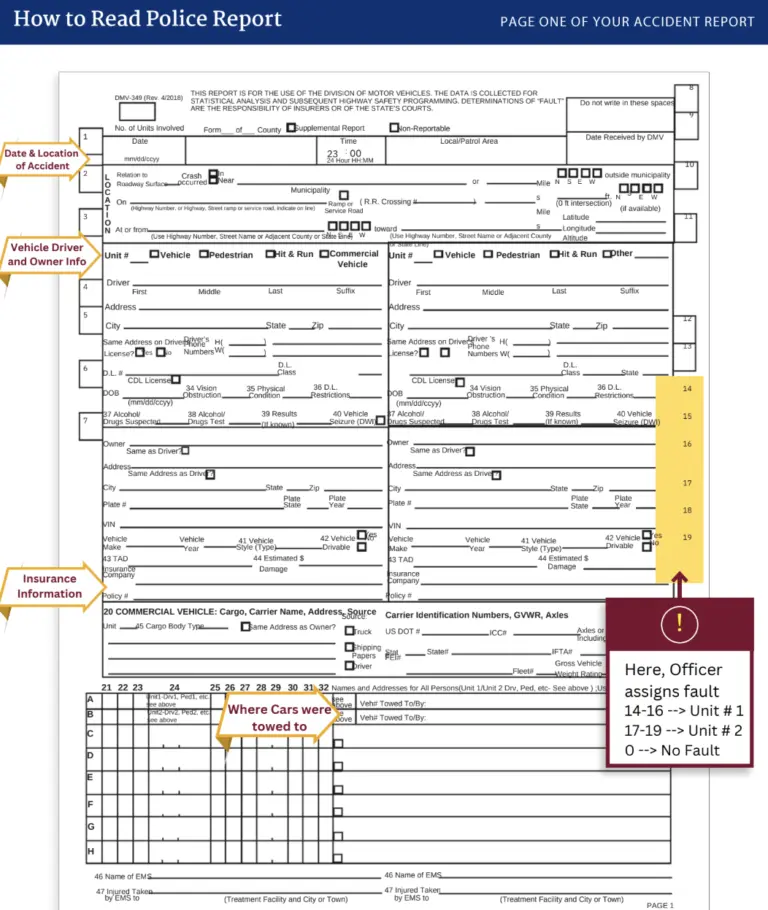
Accident Details
The opening section records the basic facts surrounding the collision, including:
- Date and time of the accident
- County and municipality
- Roadway or intersection
- Direction of travel
- Road classification
- Crash report number
Review this information carefully to make sure it accurately reflects where and when the accident occurred.
Driver and Vehicle Information
Each driver involved in the collision is identified with information that typically includes:
- Full name and address
- Driver’s license information
- Vehicle year, make, and model
- Vehicle Identification Number (VIN)
- Registration information
- Insurance carrier and policy details
Even small errors in this section can create delays when processing an insurance claim, so accuracy is important.
Passenger Information
Passengers listed in each vehicle may include identifying information, seating position, and any injuries observed by the responding officer.
Injury Severity
The investigating officer assigns an injury classification based on observations made at the accident scene.
Common categories include:
- No apparent injury
- Possible injury
- Suspected minor injury
- Suspected serious injury
- Fatal injury
Many injuries, including whiplash, concussions, and soft tissue injuries, may not become apparent until hours or even days after the collision. Seeking prompt medical care helps protect both your health and your injury claim.
Roadway and Environmental Conditions
This section documents the driving environment at the time of the crash, including:
- Weather conditions
- Lighting
- Road surface conditions
- Traffic control devices
- Posted speed limits
- Visibility
These details may help explain the circumstances that contributed to the collision.
Vehicle Damage
The report identifies the location and apparent severity of damage to each vehicle.
Damage diagrams frequently indicate:
- Front-end collisions
- Rear-end collisions
- Side-impact crashes
- Multiple points of impact
- Rollovers
The documented damage can help accident reconstruction experts and insurance adjusters understand how the collision occurred.
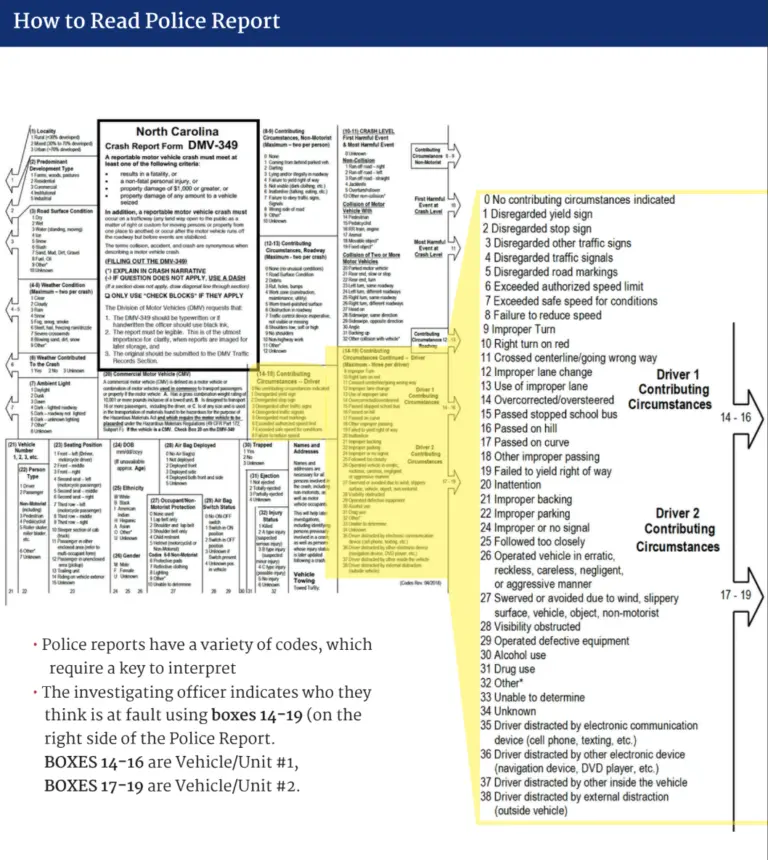
Contributing Factors
One of the most closely reviewed sections identifies conditions or driver actions the officer believes contributed to the accident.
Examples include:
- Following too closely
- Failure to yield
- Excessive speed
- Distracted driving
- Improper lane changes
- Impaired driving
- Failure to obey traffic signals
- Driver inattention
Although these observations are important, they do not automatically establish legal fault.
Officer’s Narrative
The narrative provides the officer’s written summary of the investigation and explains how the accident likely occurred based on available evidence.
The narrative may reference:
- Vehicle movements
- Point of impact
- Driver statements
- Witness accounts
- Physical evidence
- Traffic citations
Because insurance companies often rely heavily on this portion of the report, it should be reviewed carefully.
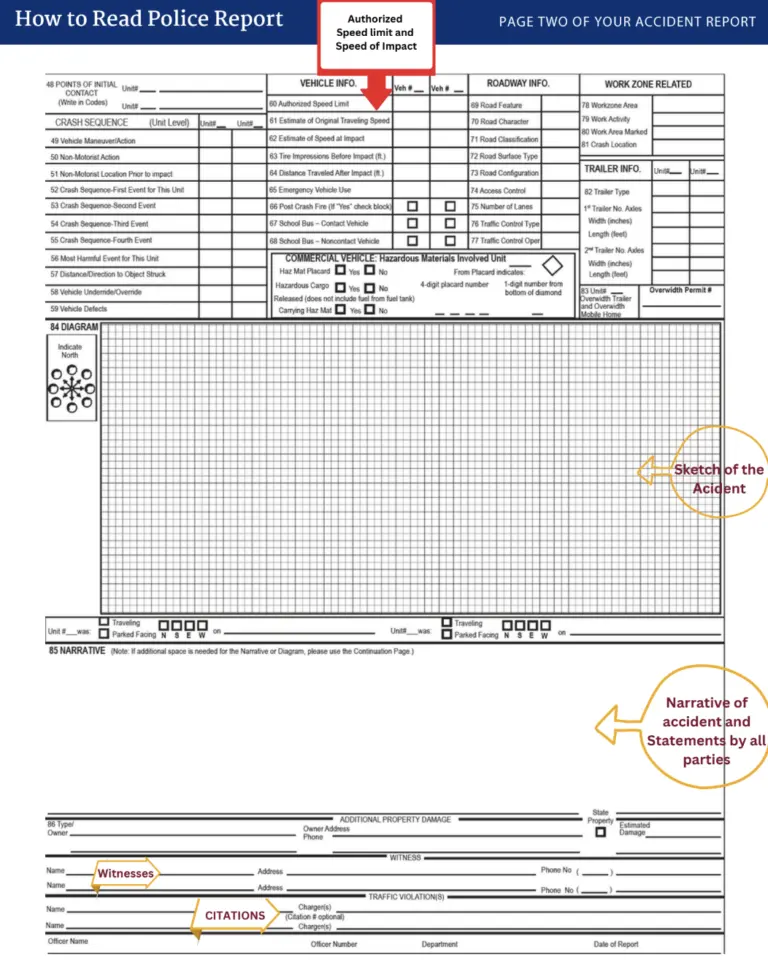
Crash Diagram
Most North Carolina police accident reports include a diagram illustrating the collision.
The diagram typically identifies:
- Vehicle travel paths
- Final resting positions
- Roadway layout
- Traffic control devices
- Point of impact
This visual representation often makes it easier to understand the sequence of events leading up to the crash.
Understanding Police Report Abbreviations and Codes
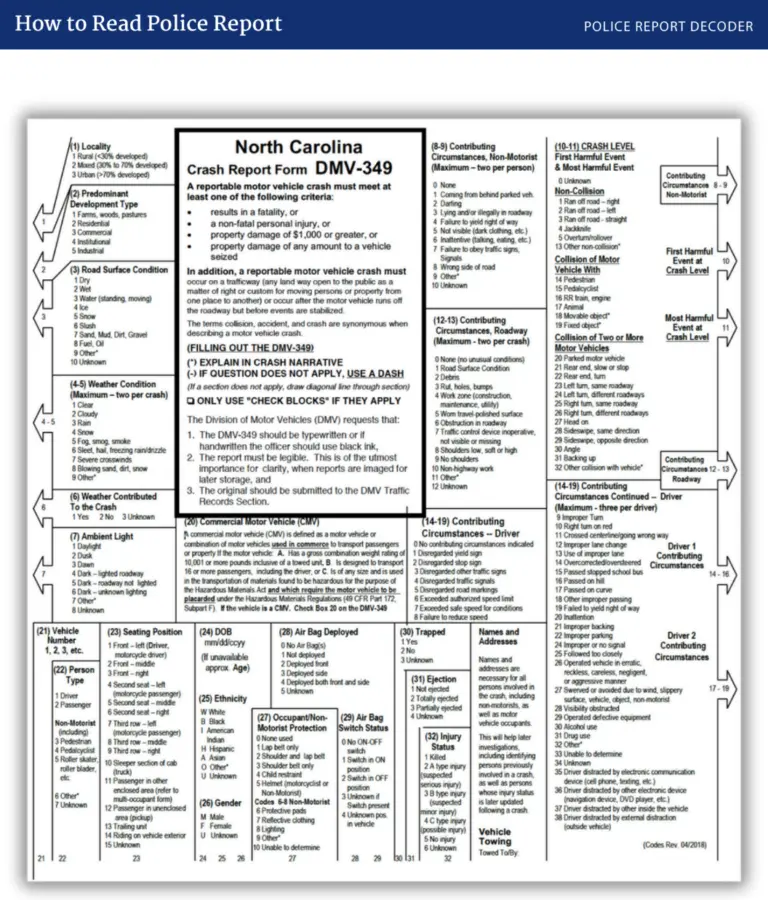
North Carolina accident reports frequently use abbreviations and standardized codes to record information efficiently.
These codes may identify:
- Vehicle classifications
- Injury severity
- Driver actions
- Road conditions
- Traffic control devices
- Collision types
If you are unsure what a particular abbreviation or code means, an experienced attorney can explain its significance and how it may affect your claim.
What Should You Do If Your Accident Report Contains Mistakes?
Even experienced law enforcement officers can make factual errors while preparing accident reports.
Common mistakes include:
- Incorrect names or addresses
- Vehicle or insurance information errors
- Missing witnesses
- Incorrect roadway descriptions
- Diagram inaccuracies
- Omitted injuries
While an officer generally cannot change investigative opinions after the report has been completed, factual errors may sometimes be corrected or supplemented with additional information.
Before requesting changes to your report, it is often beneficial to consult with an experienced car accident attorney.
Why Your Police Accident Report Is Important
Your North Carolina accident report is often one of the first documents reviewed by:
- Insurance adjusters
- Personal injury attorneys
- Accident reconstruction professionals
- Medical providers
- Defense attorneys
- Courts
Although it is only one piece of evidence, the report can significantly influence how your claim is evaluated. An attorney can review the report alongside medical records, photographs, witness statements, and other evidence to build the strongest possible case.

Frequently Asked Questions
Does a North Carolina police accident report determine who is legally at fault?
No. A police report provides the investigating officer’s observations and findings, but it does not make a legally binding determination of fault. Liability is established through the available evidence and applicable North Carolina law.
When can I obtain my North Carolina crash report?
Most accident reports become available within a few days after the collision, although processing times vary depending on the investigating law enforcement agency.
Can errors on my accident report be corrected?
Yes. Certain factual mistakes may be corrected or clarified. If your report contains inaccurate information, an attorney can help you determine the appropriate steps to address the issue.
What if I didn’t realize I was injured until after the accident?
This happens frequently. Many injuries do not develop symptoms immediately. Continue seeking medical treatment and keep records of your diagnosis, treatment, and expenses, even if your injuries were not documented at the scene.
Will the insurance company review my police report?
Yes. Insurance companies routinely use police accident reports as part of their investigation when evaluating liability and determining how to handle a claim.
What happens if the other driver disputes the officer’s report?
The insurance company will evaluate all available evidence, including photographs, witness testimony, medical records, vehicle damage, surveillance footage, and expert opinions—not just the police report.
Should I have an attorney review my police accident report?
Yes. An experienced attorney can explain technical terms, identify potential inaccuracies, determine how the report may affect your claim, and begin gathering additional evidence to strengthen your case.
Let NC Injury Law, PLLC Review Your North Carolina Accident Report
A North Carolina police accident report provides valuable information about your collision, but it represents only one part of the evidence used to pursue compensation after an accident. Understanding what your report says—and whether it accurately reflects the facts—is critical to protecting your claim.
At NC Injury Law, PLLC, our experienced personal injury attorneys are committed to helping accident victims navigate every stage of the claims process. We can review your police accident report, explain what it means, identify any concerns, and develop a strategy designed to maximize your recovery.
If you’ve been injured in a North Carolina car accident, contact NC Injury Law, PLLC today for a free consultation. We’re ready to answer your questions, protect your rights, and fight for the compensation you deserve.